Plenty of Room for Improvement in Security of Payment in New South Wales

socla logoSoCLA has submitted its response to the NSW discussion paper on last year’s admendments.

Those amendments have not gone done well in the courts:

  • McDougall J in Kitchen Xchange v Formacon Building Services [2014] NSWSC 1602 said that the  amendment to s 13(2)(c) – removing the requirement for payment claims to identify themselves as such – was “unwise”.
  • In BRB Modular Pty Ltd v AWX Constructions Pty Ltd & Ors [2015] QSC 218 the Supreme Court of Queensland had to consider a contractual provision to the same effect as the new NSW statutory requirement for supporting statements. It found that, on balance, such a requirement ran so counter to the objects of the legislation (those objects being the same in Queensland and NSW) as to fall foul of the anti-avoidance provisions.
  • These ill-considered experiments also fail to take into account the observation of Justice Peter Vickery that[2]:

We now have the luxury of more than a decade of experience derived from the “hard knocks” of litigation and the practice of adjudication. This is an excellent foundation to build upon. Most of the problems, both practical and legal, one way or another have been exposed. It is surely now time to capture the best from all jurisdictions and consolidate them into a coherent national framework.

SoCLA’s response (the drafting of which I led)  likewise urges that Continue reading

Support for the Bust?

bust

Update; see Even Less Support fo the Bust

The construction industry in Australia seems to be going through rather a hard time at the moment, and there is a fair bit of insolvency about. There is topicality in the question,

“Can a company in liquidation avail itself of the Security of Payment Legislation by validly commencing an adjudication?”

It is not hard to find examples of liquidators who take the view that the Security of Payment Legislation is available for them[1], or of adjudicators who share that view, but what is the true legal position?[2]

There appear to be no decided cases on the validity of an adjudication process where the claimant was in liquidation before commencing the adjudication. However, it is not a question that is entirely devoid of authority, and indeed the answer “no” to the question posed above emerges from Continue reading

BIM Tonight

BIMThe Society of Construction Law Australia is going from strength to strength. Tonight it is running a session on BIM in several cities; see details.

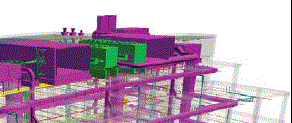
BIM is really important. Its name – Building Information Modelling – does not give much away, but it is a radically different way of designing buildings. Instead of drawing lines on a piece of paper, or digitally using a CAD system, designers insert objects into a model. The object might be, for example, a piece of glass. The object is inserted with parameters, like its location (in 3D of course). Other parameters, like the density of the glass, its thermal properties etc, will have been set by the manufacturer. Everybody involved in the project uses the same information. The BIM system will identify clashes (where for example a piece of secondary steel is seeking to occupy the same place as some ductwork). It will instantly return all sorts of data about the building (such as its thermal efficiency). Conventionally, 4D BIM provides information about time, and 5D BIM provides information about cost.

By its nature, BIM requires a cooperative approach that is obviously good for the efficiency of the construction process. It also raises interesting and difficult questions Continue reading