The Society of Construction Law Australia is going from strength to strength. Tonight it is running a session on BIM in several cities; see details.
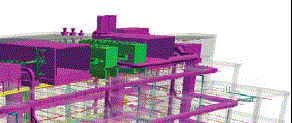
BIM is really important. Its name – Building Information Modelling – does not give much away, but it is a radically different way of designing buildings. Instead of drawing lines on a piece of paper, or digitally using a CAD system, designers insert objects into a model. The object might be, for example, a piece of glass. The object is inserted with parameters, like its location (in 3D of course). Other parameters, like the density of the glass, its thermal properties etc, will have been set by the manufacturer. Everybody involved in the project uses the same information. The BIM system will identify clashes (where for example a piece of secondary steel is seeking to occupy the same place as some ductwork). It will instantly return all sorts of data about the building (such as its thermal efficiency). Conventionally, 4D BIM provides information about time, and 5D BIM provides information about cost.
By its nature, BIM requires a cooperative approach that is obviously good for the efficiency of the construction process. It also raises interesting and difficult questions Continue reading →

 Just back from the Society of Construction Law’s 2015 Conference in Melbourne. Brilliant.